A trio of articles that nicely complement my last post “A Time to Fear:”
A Key Indicator For This Stock Market: The ‘US Advisors” Sentiment Report

A trio of articles that nicely complement my last post “A Time to Fear:”
A Key Indicator For This Stock Market: The ‘US Advisors” Sentiment Report
I.C. Angles Investment Post
“Be fearful when others are greedy, and greedy when others are fearful.” – Warren Buffett, legendary investor
Recent volatility in the stock market has served as a barometer of investor sentiment and in my analysis only further confirms my recent market call, that regardless of near term price action, long-term investors should now be fearful of stocks. Most investors far too often end up buying high, selling low and realizing disappointing returns. A case in point is the current bull market that began in 2009. For the first few years, when prices were considerably lower, investors were much more fearful than now and inclined to sell or shun stocks. Of course that is what makes for a stock market bottom and the start of a new bull market–the investment herd selling their stocks, when things are at their worst. And the financial media only serves to exacerbate matters. Pushing stories of risks around depressions, financial calamity and double-dip recessions, when the market was bottoming. But that was actually the best time to be greedy. Now prices are much higher. And the investment herd is greedy to get a piece of stock market gains, while the financial media is favoring stories about how pull backs are buying opportunities. In my opinion, now is the time to be fearful and instead use rallies as selling opportunities… that is if you’re goal is to go contrary to the herd by buying low and selling high.
Part Four: Take the Money and Run
I.C. Angles Investment Post
“You’ve got to know when to hold ‘em. Know when to fold ‘em. Know when to walk away. Know when to run.” — Kenny Rogers, country music singer
“Go on take the money and run.” — The Steve Miller Band, American rock band
Risks around stocks have risen considerably, and even long term investors should now substantially underweight equity exposure. Due to the unique characteristics of this stock market, my best advice is to now treat it as if in the onset of a bear market, regardless of near term price action. At this point in 2014 many warning signs are flashing red—the bond market is signaling weakening growth and greater risk of default, while stock market breadth has deteriorated with many stocks, including small cap and foreign indices, exhibiting extended weakness, while fewer, very large stocks were supporting the market until the recent sell off. The risk versus reward of stock exposure has become too high for an even normal stock allocation, let alone the aggressive allocation most currently posses. It’s time to under weight stocks by taking money out of the market or hedging equity exposure with relation to key technical levels.
Part Three: Malignant Growth
I.C. Angles Investment Post
The stock market is enjoying one of the strongest bull markets in its history, but the story is the opposite for the economy, where this recovery represents one of the weakest in U.S. history. And that spells bad news for investors. High-flying stock market valuations and corporate profits reverting back to more normal ranges, as covered in Part One and Part Two of “This Isn’t Going to End Well” aren’t the only reason for investors to fear an especially painful stock market decline. The particularly malignant and unsustainable nature of much of this cycle’s growth is another powerful reason to prepare for a big decline in stocks.
Part Two: Problems with Profits
I.C. Angles Investment Post
Record corporate profits are this stock market’s feet of clay. And it’s just a matter of time until they crumble. Although the rise in stock prices most recently has come largely from stocks simply becoming more expensive, as discussed in part one of “This isn’t Going to End Well” rising corporate earnings are also playing a critical role. Counter intuitively, there are two key reasons record profits are actually bad for future stock market prices. First, profits are mean reverting. History, teaches that record high profits, eventually fall and revert to their arithmetic mean over time–an action that takes stock prices lower in the process. Second, rather than strong economic growth and innovations around productivity driving profitability higher, profit growth has been increasingly generated by wage suppression and financial engineering.
Part One: Stocks are too Expensive
I.C. Angles Investment Post
The stock market is too expensive. This is what valuation methods that have been proven to work are showing. And at some point prices will decline significantly, in order for stocks to become fairly priced. Expensive valuations are just one reason, the current bull market is likely to end particularly badly, with a price decline that could very easily surpass either of the last two major bear markets. Given how high valuations have currently risen, a fall in the stock market of well over 50 percent is a very real possibility.
Recently in December I discussed that despite remaining a reluctant bull on the stock market, there are real reasons to fear a 1987 type scenario of a market crash. This is why I have recommended retail investors hold a significant cash position for over a year now despite stocks marching higher. Apparently I have some good company when it comes to this concern….
In this link, Passport Capital Founder and Chief Investing Officer John Burbank discusses his outlook for the markets and his concerns about a 1987 replay on Bloomberg TV’s ” Market Makers.”

In addition the most recent regulatory filing from Soros Fund Management reveals that the investment vehicle of legendary investor George Soros has increased its S&P 500 put option position to $2.2 billion or 17 percent of assets under management. In other words, they remain long on stocks, but at the same time have increased their investment in securities that will rise in value if the stock market were to crash.
A perfect supplement to my post from yesterday, covering how valuation metrics point to a major market decline in the future, is today’s McClellan Market Report article, “A Scary Valuation Indicator” that includes the below chart using a blend of the Cyclically Adjusted P/E ratio and Moody’s Baa yield to predict market tops, with the implication we are much closer to a major top than away from one.
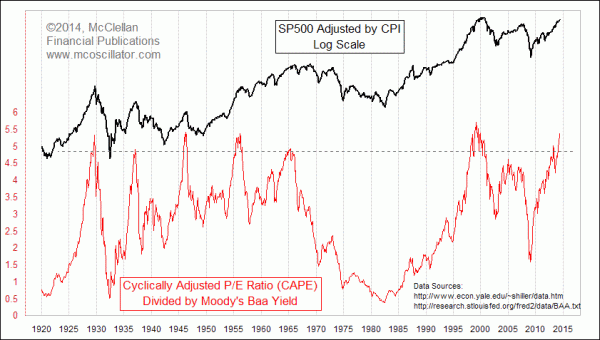
Source: McClellan Financial
I.C. Angles Investment Post…
The stock market continues to move higher, and there is no reason to bet otherwise, as long as it continues to hold support at its 125-day simple moving average. On the other hand, given underlying fundamentals, including increasingly expensive valuations, hedging your bets a bit, holding some cash and preparing for when key support fails is also a smart move. In other words, my basic outlook remains unchanged, while this bull market and economic recovery both get longer in the tooth and statistically more likely to end, as stocks keep rising.

 Investment & Communication Angles